Monday, October 18, 2010

Fall Interactive Tour


This week I went on a two-day Fall Interactive Studio Tour by Oddly Studios. We explored different interactive design firms in Toronto. The tour was very rewarding and it was interesting touring different design firms. The event was also a great opportunity to network and meet some really awesome people. Both days were jam packed with activity, so I am going to focus on my favorite moments for each day of the tour.

Day One Highlights:

Amoeba St. & John St.
Phone (Amoeba): 416-599-2699 
Phone (John St.): 416-348-0048
172 John St.
Toronto, ON M5T 1X5 


 Highlights:
  • Touring the studios (very artistic, including balloon lights, abstract art, and a Bambi painting). 
  • John St.'s Vision: We are agents of positive change and we aim to discover better ways of doing things through design. It all starts with an idea.
  • Case study on John St.'s Guy at Home in his Underwear.
    The Challenge:
    Consumer perception of the brand (Stanfield's).
    Their Goal:
    was to reinvigorate the brand with a younger more digitally-savvy audience.
  • Case study on John St.'s work with AutoTrader.
    Client’s Objective:
    Increase unique visitors to AutoTrader.ca 


Mighty 
Jon Toews - Creative Director 
jon.toews@mighty.ca
Phone: 416-927-3316
420 Wellington St. W
Toronto,
ON M5V1E3 
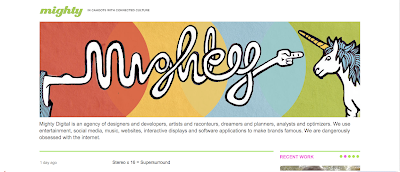
Highlights:
  • Touring the studio (artistic, 24 employees, and loved the bicycle rack in the office).
  • Case study on the Worst Parking Job Ever with Hyundai Canada.
  • Case study on Make Me Mighty.
  • To work here you need to be dangerously obsessed with the Internet.   
  • Mighty is about Measurement & Analytics, Digital Strategy & Engagement. 
  • Presentation on the Super Heroes website.
  • Presentation on the Knowing is Better website.  


Organic 
Phone: 416-874-7000
33 Bloor Street East, 14th FL
Toronto, ON, M4W 3H1


Highlights:
  • Touring the studio (artistic, moving locations so half the studio was in the process of moving, gaming area with Guitar Hero, and an amazing Lego painting).
  • Advice on the interview process (they find most employees by word-of-mouth, they invite people to contact them, main point is that interviews are given mainly based on networking).
  • The most important thing is passion, a good vibe that will match the team, and a unique portfolio. They can always teach skills later.
  • Jobs are very specific (need exact set of skills). It is good to specialize (ex. Flash Developer). 
  • Culture is very important - will you be able to fit in and work with the team?
  • It is normal to jump from agency to agency (agencies can’t support or there is better opportunity elsewhere).
  • Many designers get jobs on contract basis (which earns twice as much salary, but with no benefits). For example, a third of the designers at Organic are on a contract basis. These designers jump from contract to contract.
  • Portfolios must be: an advertisement about you (and be able to sell yourself), be interactive, show your attitude, creativity, your ideas, and your thought process.
  • You usually don’t meet with clients face to face at a digital company.
  •  If you can’t make it the way you wanted, sell it anyways! Confidence is key.
  • Have a strong online presence. For example, your portfolio website is sometimes the determining factor for an interview. Keep an eye on your online social networks (reputation on line).  Keep your online portfolio professional, with some personal touches (know your limits!)
  • Invest money into yourself (ex. good execution of portfolio).
  • Stand out (ex. video entries and do something eye catching online). You can also do something to catch the company’s attention. For example, one employee placed training bicycles outside of industries with branding on it that advertised he is fresh out of school, but willing to work hard to take off his training wheels.
  • If you can’t advertise yourself, how are you doing to be good at advertising for clients, such as Nike.
          

Jalani Morgan
Phone: 647-400-4027
jalani@jalanimorgan.com
545 King St W Studio 407
Toronto, ON M5V 1M1


Highlights:
  • Looking at his photography.
  • His passion when he talked about photography. I felt very inspired.
  • Always stick to your value system - people will notice and there will always be somebody who will relate to you.
  • Favorite photo shoot is with Lights (first big celebrity and magazine cover).
  • Don't make a solid 5 year plan, it may blind you to opportunities. Approach everyday to learning, adapting, changing, and being liquid. 
  • Always invest time into personal work. His personal work is 20% analog (since it is so expensive) and 80% digital.
  • Make sure to have blinders on since success can get to you.
  • Does web on the side, but photography is his passion.  He also wants to eventually learn video.
  • Some of his work includes photographs for John St., Verve Girl, and Much Music. 
  • Always carry around a notepad since ideas happen at anytime.
  • Forget the word “Pride”. 
  • Personal work is just as important (ex. one of his personal projects is taking portraits of people in his old pair of glasses. The project has turned into his visual signature.)
  • Social networks, such as Twitter, really helped him build up his reputation.

Pixel Gallery
Steve Di Lorenzo
Co-Founder | Creative Director | Curator
Phone: 416-889-4654


Highlights:
  • Very interesting presentation on a firm that focuses on interactive displays. 
  • Focuses on how inspiration can come from anywhere.   
  • Does art gallery spaces, such as Nuit Blanche.
  • Power of interactive displays with Sick Kids (a landscape with flowers in the waiting room that can calm people in scary situations of hearing if their child has cancer or not).
    The Challenges:
    The furniture in the hospital has to follow certain specs and be sanitized, the display of the sky and nature has to become brighter or darker depending on the time of the day outside, has to be calm and inspirational to help parents in a tough state while waiting to hear the news of their child.
  • Graffiti project (where they painted the city with light, such as the CN Tower).

Day Two:

Secret Location 
Phone: 416-849-5298


Highlights:
  • Case Study: Stanfields (The Guy at Home in his Underwear).
    • They worked with John St. on this project.
    • Live feed was donated for free.
    • Would have been over budget in two days since it is such a huge project and they needed a full-time crew at his house. 
    • Goal was 25,000 likes on Facebook in order to raise $25,000 for cancer awareness. 
    • On Day 19, 46,030 likes.
    • Half a million viewers in 8 days.
  • Case Study: In Real Life Race to Finish Website (TV Show Interactive extension of YTV).
    • Children did user testing and tested early and often.
    • Challenge: had to be 3D, but still needed to be fast loading.
    • Children can make their own levels and save them on the website, along with being able to play levels made by Secret Location.
  • Case Study: Storming Juno
    • No branding was done or would be complete until too late in the process, so they volunteered to create it themselves.
    • Interactive website that will be released this Remembrance day.

Digital Cement 
Phone: 1-800-354-0264
100 Liberty Street
Toronto, ON M6K 3L7 


 Highlights:

  • Touring the studio (very artistic in an old building, large office space with around 70 employees).
  • Life made Delicious website.
  • XM Radio – iPhone app 
  • The company is all about connecting:
    Connect to a customer, understand them.
    Connect communication activity.
    Connect to this business’ bottom line.
    Connect customers to potential customers.


Other Neat Design Firms visited:

Phone: 416-531-5263 
171 East Liberty Street Suite 252
Toronto, ON 


sociMedia
Phone: 416-530-7851
171 East Liberty Street Suite 266
Toronto, ON M6K 3P6

Monday, October 11, 2010

Ryan O'Brien, Creative Director of CTV Digital Media Group at CTV Inc.

This week’s presentation was by Ryan O'Brien, Creative Director of CTV Digital Media Group at CTV Inc. The presentation was really interesting and taught us more about the world of digital broadcasting. I have always been very interested in CTV and thought their websites were very successful. As well, I have grown up watching CTV so I was so excited when I found out we were going to meet the Creative Director. 


CTV has 50 radio and various television channels, including MTV, Much Music, and Discovery (all channels in image below). Ryan is responsible for brand management, usability, and video platforms. CTV does 200% to 300% more video than their competitors. CTV also works with creative agencies, marketing sales teams, and are running over 110 websites with a staff of 70 people. The staff is very team oriented in order to get things done. There are also several different teams within the staff. Ryan works in the digital branch of CTV. There are three different structures at CTV, which include radio, television and digital.


The presentation opened up with an interesting video about CTV. Some of the interesting points include:
  1. CTV is the #1 network for digital.
  2. Some sites include TSN.com and CTV.ca.
  3. CTV had the most online coverage for the 2010 Olympics.
  4. Primetime is now online.
  5. Much Music signed up with Vevo, which was a big contract.
  6. 50 online destinations.


Ryan started within the industry 15 years ago. Ryan grew up in Niagara Falls and attended an art high school where he became interested in audio, video, and setting up stages. Ryan got an internship in a staging complex in high school. He then attended the technical theatrical program from Humber College. He ended up apprenticing at a piercing shop after 6 months into the program. Years later he had the opportunity to shoot Breakfast television. His next big opportunity was when he started a clothing company called FuMan Skeeto, Inc. with a friend where he became the VP of online marketing and development. The company went really well and relocated to Hollywood. His clothing line was sold in big companies, such as Macy’s and Eaton’s. Ryan was responsible for production, design and development of websites, brand development, strategic consultation, and apparel design consultation. When 9/11 happened the clothing company went out of business because of the economy. He relocated to Toronto and became the Senior Web Designer for Much Music. He now works as the Creative Director for CTV Digital Media Group with a very highly skilled staff. 


CTV was one of the first companies to have television available on the web. They knew how important it was to have the transition of television on the web because Ryan and the rest of the staff have to “Live in the Future” and be 2 to 4 years ahead of their time. One of Ryan’s jobs is to give the viewer’s content that they want, and in a way that’s legal, easy, and makes money through advertising.
 
The staff has to be aware of advances in technology and has a large research department. For example, they have to be ahead of the times and know how to design for all the different browsers and platforms, such as the Blackberry, Android, and Apple products. Also, they need to be aware of 4G networks, tablets, mobile, Google OS, and other advances that involve the web.  Examples include how Google OS will always have an updated browser, Android is a different experience since you can run multiple programs at once versus the iPhone, video on the web will be better quality, how 3D television plays a effect and incorporating it on the web, and there will be around 105 tablet releases in 2011. As well, accessibility is going to be a big issue in Canada in the future. For example, the use of tabs to fill out forms and other problems since more of the older population is using the web.

CTV has to be aware of the amount of content and what content goes on all their websites. Since there are so many websites, they have to make sure there isn’t much duplication among them. An interesting event the staff got to do was attend the 2010 Olympics in order to photograph and develop stories for their websites. Another neat thing CTV did was that they offered the most online Olympic coverage in real time for the 2010 Winter Games. Also they have to be aware of right management, such as having to license songs and blurring out t-shirts that are not licensed. Since there are so many rules and so much content the team has to always be on the ball or they will miss something important and go sideways. 


One important thing when they hire is that the person looking to work for the team really knows the fundamentals of the web, since the web is always changing and moving so fast. This includes:
  1. Having knowledge of how websites work with browsers, what code means, and know the  fundamentals of coding. 
  2. Usability core sets.
  3. A good portfolio (website and coding). 
  4. Organization (you will never be the only one who works on the website, so the site needs to be   organized so your teammates can understand it). For example, always organize your folders, write notes on PDF’s, and make the files easy to understand. 
  5. Good communication skills.
  6. Passion about the Internet. 
  7. Being able to code a site in notepad.

To learn more about Ryan: 
LinkedIn
Twitter


Contact Information:
299 Queen Street West
Toronto, ON Canada M5V 2Z5
Phone: 416.384.2247
Fax: 416.384.3465
Cell: 416.371.4706
Email: ryan.obrien@ctv.ca

Monday, October 4, 2010

Presentation by Stephen Bennett, Creative Director of Juniper Park

This week’s speaker was Stephen Bennett, Creative Director of Juniper Park. I have been a fan of Juniper Park’s work since last spring, so I was so excited to meet Stephen and learn more about the company. Stephen loves everything digital. He tells us about some of his story, such as where he has worked. He worked in places he calls “Pure Play,” which means just digital, such as Blue Zone, Mod7, Blast Radius, Ninedots, which then changed it’s name to Henderson Bas. He also worked in “Integrated Jobs,” which involve digital and print, such as McLauren McCann, Grip Limited, and Juniper Park.


Juniper Park is a new company that is less than 3 years old. The company has 75 employees, including art directors, designers, writers, developers, producers, and strategists. Juniper Park is a place where advertising, strategy, and design come into play. The company creates broadcasts, print, out of house, digital, and statements.


Juniper Park uses the vendor model and they hire a lot of freelancers, which makes them different. Quaker and PepsiCo are two very big clients. Juniper Park does a lot of work for the United States, but some work for Canada as well. Their clients include:


One of my favorite brands they worked on is Woman’s World.


Stephen asked us to think about if we wake up tomorrow and a company was gone, would we care:
1.)    Companies sell products.
2.)    Brands sell ideas.
3.)    A brand narrative is the story that is shared between people
        as they gather around a brand.
4.)    Great ideas need to be embraced and be talked about.

A brand he explains as one that matters is Apple. Their secret is that they know people are creative, but lack the tools needed to set them free. Apple’s gift is making simple tools to let people become more creative. Apple focuses on humanity, while Microsoft and IBM focuses on efficiency. For example, Ipod's advertisements show a creative and free lifestyle.

He goes on to talk about the secret that SunChips knows, which is one of Juniper Park’s clients. They know each small step can make a difference. SunChips' gift to the consumer is that it is a company that brings you healthy wholegrain chips and makes small steps for a better planet. For example, SunChips use solar panels and their new packaging is the first 100% compostable chip bag.


“Create the bigger stories, so we do care.”


Another one of their client’s is Quaker. This company asks if your breakfast makes you amazing. Quaker’s secret is that amazing mornings can lead to amazing days. Their gift to the consumer is that the right breakfast leads to a great day. Juniper Park and Quaker have also worked with Bob Harper from Biggest Loser, who is the new digital coach for Quaker and has already had a big digital footprint on the web.


A few things he has learned include:

1. It's not about who you know, it's about who knows you.
   
Juniper Park is moving so fast they don’t have time to look through resumes. He selects people for freelance based on who is contacting him and letting him know they want to work for Juniper Park. He told us not to worry about feeling like you are pestering the company by sending many emails.

2. Make friends.

Stephen explained how important it is to connect to the industry since most companies don’t have time to post jobs. People always call whom they know first. A great base for this is attending industry events.

3. Be curious.

The moment you stop being curious, you should think about doing something new since the industry moves so fast.

4. It’s a creative evolution baby. Take your time.


5. Execution is everything.

Great ideas get lost when not executed right, such as spelling mistakes, not sweating the details, and not presenting yourself well.

6. What's your story? Have a story. Use your words to brand yourself, a way for anyone to remember you by.

Stephen also talks about how cultural latency is nearing zero. People don’t want to wait. The web changes constantly and you have to continually stay on top of it or your website will be quickly outdated. You have to be adaptive and ready for change.

Stephen ends the presentation by talking about how searching for things you are interested in is becoming more useful with viewzi. This website helps you find what you are interested in with a new and visually appealing approach.

One last thing we talked about includes what would your brand narrative be if explained with a chair. Below are examples he showed us. What would your chair look like?


Contact Information
2 Bloor St. W. 6th Floor, Toronto, ON, M4W 3R6
P: 416.972.5745
F: 416.972.5486
C: 416.357.8945
stephen.bennett@juniperpark.com

Monday, September 27, 2010

Social Media 101 – Meg Kerr

Who is Meg Kerr?

This week’s presentation was from Meg Kerr, Social Media Integration Manager at Mosaic. Meg Kerr’s job is to manage social media strategies, community management, analyzing, and blogs of various companies. Meg has been with Mosaic since 2006 and full time since 2007. Meg has an undergraduate degree from The University of Western Ontario in Media in Information and Technoculture. She also has a degree in Broadcast Journalism from Fanshawe College.


What is social media and why should we care?

Meg showed us a few quotes on what social media is. One of these quotes is: “Social media is an umbrella term that defines the various activities that integrate technology, social interaction, and the construction of words, pictures, videos, and audio.” – Wikipedia. 

Meg also showed us a video called “Social Media Revolution,” which shows us exactly why we should care about social media.

What are the four social media trends?

Trend One:  Real time and smartphones changes everything

Meg explained how technology allows anyone to share and search for information in real time and from anywhere. It has changed how we get information. It’s traditional word of mouth, but on steroids. Nearly half of Canadians own a smartphone and web traffic on smartphones in Canada grew 193% in the past year. By 2013, mobile phones will overtake personal computers.

An example of real time news is the Tiger Woods scandal. @breakingnews on Twitter was the first outlet to break the story. People are starting to use Twitter for news since they get it quicker. However, there is an issue on speed versus accuracy.

Trend Two: Location based

The increase of GPS enabled smartphones is a driving force behind the rise in popularity of  location based services – they would not exist without this technology. An example of this service is Foursquare, which works by checking you into locations from your phone. Your Foursquare friends are pinged when you check into a location. You can get points for checking into different locations, can unlock badges, and even be named “Mayor” if you’re checked into a location more than anymore else. Friends can find out when you went into a restaurant and give you tips, such as to order the nachos or to leave because of bad service.

More facts on location based services:
  • Foursquare currently has 3 million users (1 million in March)
  • Twitter took 2 years to hit 1 million
  • Foursquare took ½ this time
  • Last November, Twitter added the ability to Geotag
  • In the past month Facebook rolled out Facebook places
  • Facebook places should arrive in Canada in the next year since it’s currently only available in the USA
  • To be determined what effect Facebook places will have on Foursquare
  • Location based services are in the mainstream 

Trend Three: Privacy

In order to attract users, the sites must restrict information:
  • Twitter is the least private and is nearly completely open
  • You can read anyone’s tweets, whether following them or not
  • Tweets are indexed in Google
  • People often link their Foursquare to their Twitter account, which can show the whole entire world where you are in real time
A site the helps you be aware of the safety of location based services is pleaserobme.com. In this website you can search Toronto and find out people who are not in their homes because of their tweets. This website gives awareness to be selective to where you post your Foursquare and who your friends are on the site. The main point is to never link Foursquare to your Twitter.


Trend Four: Social media gets less social

Meg explained how first and second generations of social networking portals were about opening up to the world. However, the third generation is about closing it again. For example, exclusive niche networks are becoming more popular. Examples include Blue Chip Expert where you have to submit a resume and be selected to become a member. Another example is A Private Club which is a social networking website that is for popular and successful New Yorkers. The top seven countries that use Facebook are actually declining in overall number of users. The novelty of first and second-generation social networking websites is dying off.


A site I found interesting that Meg talked about was Web 2.0 Suicide Machine. This website allows you to permanently delete several networking sites, such as your Facebook and Twitter, in a quick and easy way. Some of the stats of this site include:
  • 1,176,563 friends have been unfriended
  • 504,978 tweets have been removed since launching
  • 4,344 people went before you!

Other information I found interesting in the presentation includes how if you are paid to blog, you will be fined if you don’t disclosure the information. As well, one in eight couples met online in North America. Overall the presentation was very interesting and taught me a lot of interesting facts about social media.

Meg Kerr’s Contact information:
Mississauga, Ontario L4W 4V9
Phone: 905-238-8422
Twitter: @meg_kerr

To find out more about Mosaic, visit their website.

Sunday, September 19, 2010

Jay Schacher - Senior Designer at Henderson Bas

This week’s presentation was from Jay Schacher, Senior Designer at the most awarded digital design agency, Henderson Bas. The presentation was very informative. I saw a speaker from Henderson Bas last spring, so I was excited to learn more about this company.


Jay is an interactive designer who has graduated from York University for Visual Arts and Multimedia. As well, he has graduated from the Web Design program at Sheridan College in 2006. After graduating he entered into the Toronto design agency two weeks after school at an agency called Organic. His first big website in the field was for Jamieson.


Jay specializes in interactive web experiences, online advertisements, mobile, and print. Jay is passionate about talking about Henderson Bas and explains that there are around 80 employees. He says one of the best parts of the atmosphere is the culture, which is both fun and exciting to him.  In the creative department there are 4 juniors, 3 seniors, 3 art directors, 1 associate creative director, and 1 creative director.

Jay’s roles and responsibilities include brainstorming, making concepts, designing, overseeing work, and meeting timelines. Some brands he has worked on include Coco Cola, Nintendo, Tim Hortons, Kraft Dinner, Dillions, Infusion, Timex, and LG.

He explains that he reports directly to the art director, and once the art director approves the work, they go to the creative director. After approval, the project is submitted to the account manager to ensure that it is ready to show the client. The client then will be allowed to ask questions and have input for a round of review. I found this process really interesting since each design firm does the process a little differently.

When asked about how many hours he works, he explains hours are based on a value system. He gets a set number of projects per week, and it’s up to him to set the hours so he can get everything completed. For example, he could get one large e-commence site or various projects on the go at once. This is not a typical 9 to 5 job, since it is a company where you work extra hours to build up an amazing portfolio and win awards. If you are not done your work at 5, you are expected to stay and finish. Jay enjoys this since he likes being challenged and likes winning awards and creating an amazing portfolio.

Jay then starts showing us examples. He showed us LG Shrine Plus. He also talks about the website Get Connected. At this point in the presentation I was so excited since I have come across both of these websites before and I loved the design and usability in them! He also talks about how the company stays away from stock photography, which I find interesting.


Jay also explains how they design these projects. They first brainstorm, sketch the concept, present, design, build, and then revise. He shows us a great example of the whole entire process with a Mercedes Brenz project. He showed us examples of the concept, the brainstorming, and the idea behind the website. This process moves fast. The company usually spends two days on concept, two days on design, and finish the design in a week and a half while working on various other projects. He explains, sometimes the deadlines are shorter or longer depending on the project.


He also expands on the subject by showing us how many revisions he has to do on a simple navigation bar. Sometimes a few hours of work turns into days of work because of revisions that the client wants you to complete. For this reason, he explains how we should cherish our student work and enjoy projects that we can be creative with.

A job he has really enjoyed was TIMEX because he got to be completely creative and incorporate his own creative freedom since there was not many guidelines or rules. He is also not a fan of site maintenance since he really enjoys being creative.


His advice that works include:
1.)    Stay close with classmates.
2.)    Network a lot and use online networking, such as LinkedIn.
        (Networking is how he got a job at Henderson Bas.)
3.)    Be a team player, not a hero. As well, don’t have an ego!

When he was asked about how much he makes, he didn’t give an amount but he did say he makes double the amount he started off with and gets great benefits, such as a drug plan, dental, and RSPs. He also explains side jobs, such as contracting can be more high paying, but shorter termed. He also explains to us that when we start off as junior designers, we should ask for 35,000 to 55,000 for our yearly salary. He also explains how Creative Niche is very helpful.

When Jay finished college, his 5-year plan was to be an art director, which he has almost succeeded on. He plans on staying in Toronto since he loves the culture, the industry, and it is the third largest location for design in North America. He wants to eventually become a creative director and one-day (in the far future) start up his own company.

Some things he would approach differently if he took the Sheridan Web Design course again include focusing on typography a lot more. As well, networking more outside of class and to go on more tours.

To learn more about Jay’s work and for contact information, you can visit his portfolio.

Henderson Bas:

Website 
Twitter
Facebook

479 Wellington St. W.
Toronto, ON
M5V 1E7
416-977-6660

Sunday, September 12, 2010

My first week at Sheridan

I had a great first week at Sheridan. Some highlights of the week include:

1.) Meeting my classmates and the teachers was a great experience. I was so pleased to know how amazing and friendly both the other students and teachers are. I can just tell these teachers will be great and helpful. I am looking forward to starting three new classes next week and learning more in classes that have already been started.

2.) I was so excited to find out we were all given a copy of CS5 creative suite. To make it even better, Colin Smith from Adobe came to show us new features. I have already heard of all these features from articles on the web, but seeing these features in a real life presentation brought them to a new level and helped me understand how to use them.

3.) Moving into my new home that I am renting was a good experience. I was pleased to know that both my roommates are great people and both are very talented artists.

Overall, I have been very pleased with my first week at Sheridan College and I am looking forward to the weeks and months to come. I feel like my design skills and knowledge of the industry and marketing are going to improve another one hundred percent!